

Africa stands at a defining moment in its development journey. Across the continent, governments are under increasing pressure to expand access to electricity, strengthen climate resilience, modernise infrastructure, and meet growing social and economic needs.
At the same time, many are grappling with rising public debt, tighter fiscal conditions, and limited access to affordable financing. This challenge is particularly acute in the context of climate change.
Yet, many African governments have little fiscal space to make these investments because growing proportion of government revenues is now devoted to servicing debt, leaving fewer resources available for infrastructure, healthcare, education, and climate adaptation.
This reality has prompted policymakers, development finance institutions, and international partners to explore innovative financing mechanisms capable of unlocking investment without placing additional pressure on already constrained public finances.
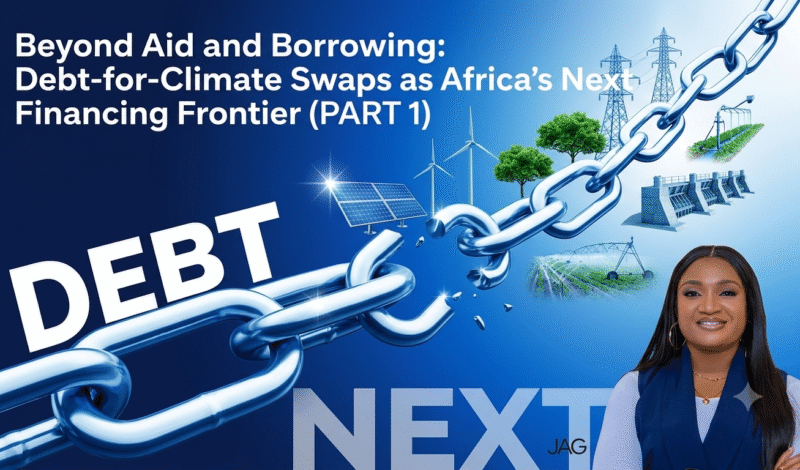
Among the financing instruments receiving increasing global attention is the debt-for-climate swap.
What Is a Debt-for-Climate Swap?
A debt-for-climate swap is a financial arrangement under which a creditor agrees to reduce, restructure, refinance, or modify part of a countr’s debt in exchange for the country’s commitment to invest an agreed amount in climate-related projects or environmental programmes.
The underlying principle is relatively straightforward.
Instead of requiring a government to devote every available financial resource to debt repayment, the creditor agrees to more favourable debt terms. In return, the government commits to investing part or all of the resulting savings in projects that generate measurable environmental or climate benefits.
Importantly, debt-for-climate swaps do not eliminate debt altogether.
Unlike traditional debt relief programmes, where debt is forgiven without any specific obligation regarding how the resulting fiscal space is used, debt-for-climate swaps require governments to channel agreed financial resources toward clearly defined climate objectives.
These objectives may include investments in renewable energy, climate adaptation, reforestation, biodiversity conservation, sustainable agriculture, coastal protection, water resource management, or other initiatives that contribute to climate resilience and environmental sustainability.
In most cases, the debt is restructured rather than cancelled entirely. The restructuring may involve reducing the principal amount, extending repayment periods, lowering interest rates, refinancing expensive debt with cheaper financing, or introducing other terms that improve debt sustainability.
The financial savings generated by these changes become the source of funding for climate investments.
This distinction is important because debt-for-climate swaps should not be viewed primarily as debt forgiveness initiatives. They are better understood as innovative financing arrangements that seek to align sovereign debt management with sustainable development objectives.
In other words, they recognise that improving a country’s long-term financial stability and strengthening its climate resilience are not mutually exclusive goals. Properly designed, both objectives can reinforce one another.
Another important feature of debt-for-climate swaps is that they create accountability.
The climate investments are typically governed by clearly defined agreements specifying how funds will be used, how projects will be monitored, and how environmental outcomes will be measured. This helps ensure that the fiscal benefits arising from the debt restructuring are directed toward the intended purposes rather than being absorbed into general government expenditure.
For many developing countries, particularly those facing significant climate vulnerabilities, debt-for-climate swaps offer a way of transforming financial pressure into productive long-term investment.
Instead of viewing debt solely as a burden, these arrangements seek to convert part of that burden into an opportunity to finance sustainable development.
How Does a Debt-for-Climate Swap Work?
To illustrate, consider a simplified example.
Assume that a country owes US$500 million to a creditor and is required to make annual debt service payments of US$50 million.
Following negotiations, the creditor agrees to restructure the debt so that annual repayments are reduced to US$35 million.
The restructuring creates annual savings of US$15 million.
Under the debt-for-climate swap agreement, the government commits to investing those savings in agreed climate initiatives, such as renewable energy projects, climate adaptation programmes, sustainable agriculture, or coastal resilience infrastructure.
The country benefits from lower debt servicing obligations while simultaneously financing investments that contribute to long-term sustainable development.
The creditor, meanwhile, secures a more sustainable repayment arrangement while supporting internationally recognised climate objectives.
The result is a financing structure intended to produce benefits for both parties while advancing broader environmental goals.
Benefits of Debt-for-Climate Swaps for Africa
- Rising Debt Servicing Costs
One of the most pressing fiscal challenges confronting many African countries is the growing cost of servicing public debt.
Over the last decade, borrowing has increased across the continent as governments sought to finance infrastructure, respond to the COVID-19 pandemic, cushion the effects of global economic shocks, and support economic recovery. At the same time, higher global interest rates and tighter financial conditions have increased borrowing costs, making debt repayment more expensive.
For many governments, debt service now consumes a significant share of annual public revenue.
Debt-for-climate swaps cannot eliminate these obligations entirely, but they can help reduce debt servicing pressures and allow governments to redirect part of the resulting fiscal savings toward investments that strengthen long-term economic resilience.
- Limited Fiscal Space
Fiscal space refers to a government’s ability to increase spending without compromising fiscal sustainability or macroeconomic stability.
Many African governments currently have very limited fiscal space.
Under these conditions, increasing expenditure often requires additional borrowing, which may further worsen debt sustainability.
Debt-for-climate swaps offer an alternative approach. Rather than relying exclusively on new borrowing, governments can negotiate improved debt terms that create additional fiscal capacity without necessarily increasing overall indebtedness.
- Climate Vulnerability
Africa contributes only a small fraction of global greenhouse gas emissions, yet it remains one of the regions most exposed to the effects of climate change.
Responding to these challenges requires substantial public investment.Countries must invest not only in reducing emissions but also in adapting to the impacts of climate change that are already unavoidable.
Debt-for-climate swaps provide one possible avenue for mobilising additional resources for these investments while easing fiscal pressures.
Strengthening Investor Confidence
Well-structured debt-for-climate swaps can also send a positive signal to investors and development partners.
They demonstrate a government’s willingness to pursue innovative financing solutions, strengthen fiscal sustainability, and invest in long-term development priorities.
When accompanied by transparent governance arrangements and credible implementation frameworks, these transactions can enhance confidence in a country’s broader economic reform agenda.
For African governments seeking to attract investment while managing debt sustainably, this reputational benefit should not be overlooked.
What is the Incentive for Creditors?
Debt-for-climate swaps are not acts of charity. Creditors participate because the transactions can also serve their interests.
Restructuring debt may allow them to recover more than they would under a sovereign default while reducing repayment risk.
Many creditors also have environmental, social and governance (ESG) commitments, making these transactions an opportunity to support measurable climate outcomes. In addition, debt restructuring can improve the quality of their investment portfolios, strengthen diplomatic relationships, and enhance their reputation as responsible financiers.
Ultimately, the strongest debt-for-climate swaps create value for both parties: governments gain fiscal space for climate investment, while creditors improve repayment prospects and advance broader strategic objectives.
Challenges and Criticisms
Debt-for-climate swaps are not a cure for sovereign debt challenges. They typically restructure only a portion of a country’s debt and cannot replace prudent fiscal management.
These transactions can also be legally and financially complex, requiring extensive negotiations and strong institutional capacity. Their success depends on transparent governance, effective monitoring, and the willingness of creditors to participate.
Furthermore, while valuable, debt-for-climate swaps remain relatively small compared to Africa’s overall climate financing needs and should be viewed as one tool within a broader financing strategy.
In part 2 of this article, the structure of debt for climate swaps will be discussed as well as case studies of its successful implementation globally.
References
African Development Bank (AfDB) (n.d.) Sustainable Energy Fund for Africa (SEFA). African Development Bank. Available at: https://www.afdb.org/en/topics-and-sectors/initiatives-partnerships/sustainable-energy-fund-for-africa(Accessed: 10 July 2026).
Federal Ministry for Economic Cooperation and Development (BMZ) (n.d.) Debt-for-Climate Swaps. Berlin: Federal Ministry for Economic Cooperation and Development. Available at: https://www.bmz.de/en/issues/climate-change-and-development/climate-financing/debt-for-climate-swaps-195550 (Accessed: 10 July 2026).
Chamon, M., Klok, E., Thakoor, V.V. and Zettelmeyer, J. (2022) Debt-for-Climate Swaps: Analysis, Design, and Implementation. IMF Working Paper No. 2022/162. Washington, DC: International Monetary Fund. Available at: https://www.imf.org/en/Publications/WP/Issues/2022/08/11/Debt-for-Climate-Swaps-Analysis-Design-and-Implementation-522184 (Accessed: 10 July 2026).
Inter-American Development Bank (IDB) (2023) Ecuador Completes Historic Debt Conversion for Marine Conservation in the Galápagos. Washington, DC: Inter-American Development Bank. Available at: https://www.iadb.org (Accessed: 10 July 2026).
Organisation for Economic Co-operation and Development (OECD) (2026) Climate Finance Provided and Mobilised by Developed Countries in 2013–2024. Paris: OECD Publishing. Available at: https://www.oecd.org (Accessed: 10 July 2026).
World Bank (2021) Climate Change Action Plan 2021–2025: Supporting Green, Resilient and Inclusive Development.Washington, DC: World Bank. Available at: https://www.worldbank.org/en/topic/climatechange (Accessed: 10 July 2026).