
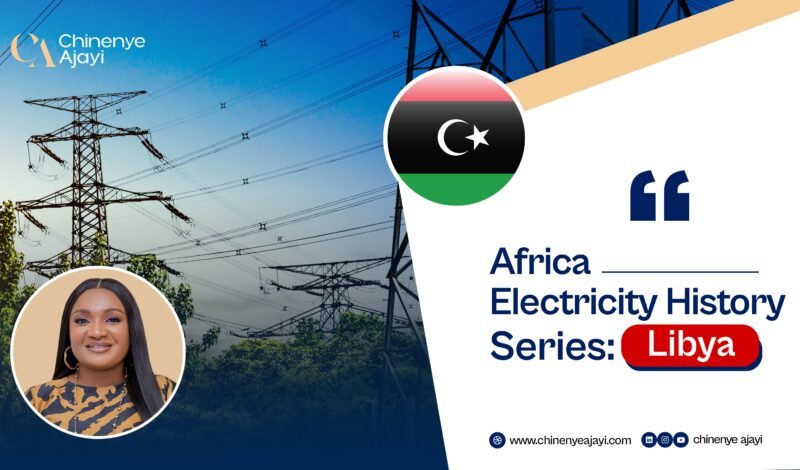

Article 3 of the African Energy History Series
Libya occupies the centre of North Africa’s Mediterranean coastline. It is one of Africa’s largest countries by land area, at approximately 1.76 million square kilometres, but one of its most sparsely populated, with around seven million people concentrated almost entirely in a narrow coastal strip. The interior is overwhelmingly Sahara Desert.
Libya holds Africa’s largest proven oil reserves, estimated at 48 billion barrels as of early 2024, representing approximately 41% of the continent’s total. This fact, more than any other, has shaped everything about how Libya generates, distributes, and pays for electricity, and explains why a country of extraordinary resource wealth finds itself, as of mid-2026, struggling to keep the lights on.
The Pre-Independence Electricity Journey
- Italy colonised Libya from 1911. Urban infrastructure, including electricity, was built along strict racial lines: Italian neighbourhoods received modern services; Libyan quarters received minimal investment.
- Most of what Italy built was destroyed during World War II, as Libya became one of the major North African battlefields between the Axis and Allied forces. From 1943 to 1951, Tripolitania and Cyrenaica were under British military administration and Fezzan under French control, with no significant electricity infrastructure development during this caretaker period.
- Libya gained independence on 24 December 1951 becoming the first African country to achieve independence through the United Nations. At that time, electricity access outside of small urban areas was virtually non-existent. There was no national grid.
- The discovery of oil at Zelten in 1959, and the rapid growth of Libya’s oil industry through the early 1960s, transformed the country’s fiscal position drastically. The first serious electricity infrastructure investment came from oil revenues. This means that Libya’s electricity system was built on oil wealth from its earliest stages, not on the slow accumulation of institutional capacity, cost-recovery mechanisms, or technical expertise that a more gradual development path might have produced.
Oil-Funded Expansion and Almost Free Electricity
- The Idris-era Kingdom began establishing basic electricity infrastructure using oil revenues through the 1960s, extending supply progressively into urban centres.
- On 1 September 1969, Muammar Gaddafi, came into power and embarked on a radical restructuring of the economy along pan-Arab nationalist and socialist principles. The electricity sector, like everything else, would be rebuilt around the state as the sole actor and oil as the sole financial engine. Electricity was made effectively free under Gaddafi, subsidised entirely by oil revenues.
- Tariff rates were set at approximately $0.028 per kilowatt-hour, far below the cost of providing the service. This policy achieved rapid access expansion and broad popular support. It also eliminated any financial basis for the electricity system to sustain itself independently of the state treasury funded by oil revenues.
- The General Electricity Company of Libya (GECOL) was formally established in 1984, consolidating generation, transmission, distribution, and sales under a single vertically integrated state monopoly. GECOL remains the only electricity company in Libya as of mid-2026.
- By 2010, Libya’s electrification rate had reached approximately 80% of the population and GECOL served approximately 1.2 million customers. Total installed capacity was approximately 6.8 GW, generated entirely by oil and gas plants. At this time Libya had no meaningful renewable energy capacity of any kind.
- By 2011 conflict, when conflict arose, the system was under strain. The transmission network was described by infrastructure analysts at the time as severely dilapidated. Demand had more than doubled between 2000 and 2010, driven by population growth, high living standards fueled by oil revenue, and the intensive air conditioning needs of a country where summer temperatures regularly exceed 40 degrees Celsius. It points to the conclusion that when electricity is free, consumption is limited only by availability.
- One dimension of Libya’s electricity system often overlooked in external analysis is its relationship to water supply. The Great Man-Made River, one of the world’s largest infrastructure projects, pumps water from Saharan fossil-water aquifers to coastal populations through underground pipelines. Those pumping stations are entirely dependent on GECOL’s electricity supply. Power outages in Libya are were almost life threatening as they directly interrupt the water supply for large parts of the population.
Conflict, Collapse, and Fragmentation
- The conflict that led to Gaddafi’s death caused direct damage to electricity infrastructure, and skilled foreign technical staff departed leaving critical maintenance gaps.
- Political fragmentation at the time had direct and severe consequences for GECOL. Armed groups attacked plant and transmission assets, stole electrical equipment, and disrupted fuel supplies. Maintenance halted repeatedly due to security risks. Per reporting by the UN Panel of Experts in late 2024, armed groups siphoned at least 1.13 million tonnes of diesel from GECOL’s fuel depots in Benghazi since 2022.
- Power plants and transmission lines were, in the words of one assessment, treated as spoils of war. Rival political administrations made contradictory decisions, and no authority could make credible national-level commitments to investors, contractors, or reform processes.
- Major projects that begun before 2011, including the Gulf steam power station and the West Tripoli steam power station (both designed as four-unit plants with 1,400 MW capacity each), were left unfinished. As of July 2026, the West Tripoli project remains incomplete, and only two of Gulf’s four units have been connected to the grid.
- A 2022 UN sector study found Libya had approximately 10,236 MW of installed capacity, but average actual output was only approximately 5,300 MW, falling to around 3,700 MW in summer heat, against peak demand exceeding 7,600 MW. Maintenance backlogs exceeded $2 billion. GECOL was recovering approximately 10 to 13% of its operating costs from tariff revenues.
- Libya’s electricity access rate, which had reached approximately 80% in 2011, declined to approximately 73.2% by 2023, the only country in this North Africa series where electricity access went backwards over the decade. This reversal was caused by conflict and governance failure, not by economic underdevelopment. Indeed, it is a rare and sobering data point, that infrastructure built over decades can be degraded within years by political instability.
Recent State and Current Situation
- Some improvement in electricity supply occurred in 2023 and 2024, particularly in Tripoli, attributed partly to greater political stability in the western region and partly to gas-fired capacity contracted before 2011 finally coming online.
- As of July 2026, with temperatures exceeding 48 degrees Celsius, GECOL reported demand of approximately 7,500 MW against available generation of approximately 4,500 MW. Outages in Tripoli ran to 14-20 hours per day and this led to public protests, with demonstrators storming buildings affiliated with Libya’s National Oil Corporation. GECOL issued warnings about the risk of total grid collapse and the immediate causes included fuel shortages, pipeline disruptions by armed groups, and the ongoing effects of unfinished strategic projects.
- Libya’s renewable energy potential is very apparent: solar irradiance of approximately 7.1 to 8.1 kWh per square metre per day, among the world’s highest, yet with near-zero installed renewable capacity. The IEA recorded Libya’s renewable share at 0.01% of final energy consumption in 2021.
- However, a new National Renewable Energy and Energy Efficiency Strategy, adopted in 2023, targets approximately 4 GW of renewable capacity by 2035, with 1.7 GW by 2026. Concrete projects now in development include TotalEnergies’ 500 MW Al-Sadada solar park in Tripoli, expected to commence commercial operation in 2026 amongst others.
- Energy subsidies remain at 86 to 91% across energy products and as of 2023, among the highest in the world. GECOL’s revenue covers approximately 10% of its operating costs. Tariff reform is politically near-impossible in a fragmented governance environment where no authority commands sufficient legitimacy or security to impose price increases on a population already enduring daily blackouts.
Conclusion and Reflections
- Libya’s electricity story is, at its core, about what happens when resource wealth replaces governance as the organising principle of a public service. Free electricity was funded by oil money, and though it achieved energy access expansion and popular support, there were no insititutional foundations. A system that factored in cost recovery, maintenance financing, technical capacity, or regulatory independence would have made the system resilient.
- The gap between Libya’s installed capacity on paper (over 10,000 MW) and what can actually be delivered in practice (around 4,500 MW) is an illustration of the difference between building infrastructure and maintaining it. Maintenance requires revenue; revenue requires cost recovery; cost recovery requires either price reform or stable public financing. None of these seem to be the case with Libya.
- Political fragmentation has not merely damaged physical infrastructure; it has made every structural reform almost effectively impossible. Tariff reform, private investment frameworks, and regulatory independence all require a counterparty capable of making and keeping commitments. In Libya’s current divided governance environment, that counterparty does not exist at a national level. This is a reminder that energy sector reform is inseparable from political structure. In addition, technical and financial solutions cannot function in an institutional vacuum.
- Libya’s renewable potential is real. The constraint is not the solar resource or the capital; it is the absence of a credible operating environment.
Highlight of References
Africa Energy Portal (2024) ‘Libya’. Available at: https://africa-energy-portal.org/aep/country/libya (Accessed: July 2026).
Al Jazeera (2026) ‘Libya electricity blackout protests expose country’s failing grid’, 29 July. Available at: https://www.aljazeera.com/economy/2026/7/29/libya-electricity-blackout-protests-expose-countrys-failing-grid (Accessed: July 2026).
Britannica (2025) ‘Libya — History’. Available at: https://www.britannica.com/place/Libya/History (Accessed: July 2026).
Devex (2024) ‘General Electricity Company of Libya (GECOL)’. Available at: https://www.devex.com/organizations/general-electricity-company-of-libya-gecol-159741 (Accessed: July 2026).
Energypedia (2023) ‘Libya energy situation’. Available at: https://energypedia.info/wiki/Libya_Energy_Situation (Accessed: July 2026).
ESI-Africa (2025) ‘Libya: Renewable energy drive, with 500MW solar project lined up’, 29 January. Available at: https://www.esi-africa.com/renewable-energy/libya-500mw-solar-project-lined-up/ (Accessed: July 2026).
Grokipedia (2026) ‘Italy–Libya relations’. Available at: https://grokipedia.com/page/Italy–Libya_relations (Accessed: July 2026).
International Energy Agency (IEA) (2024) ‘Libya — countries & regions’. Available at: https://www.iea.org/countries/libya (Accessed: July 2026).
U.S. Energy Information Administration (EIA) (2024) ‘Libya’. Available at: https://www.eia.gov/international/analysis/country/LIB (Accessed: July 2026).
This article is part of an independent historical research and writing series examining the development of electricity and power systems across African countries. It is compiled for educational purposes, to help readers understand where these energy sectors began, how they evolved, and what lessons might be drawn for the future. The content draws on publicly available sources, including institutional records, academic literature, government documents, and news reporting, and is current as of mid-2026. This article does not constitute professional, legal, financial, or investment advice. Readers are encouraged to consult qualified professionals for any decision-making purposes.