
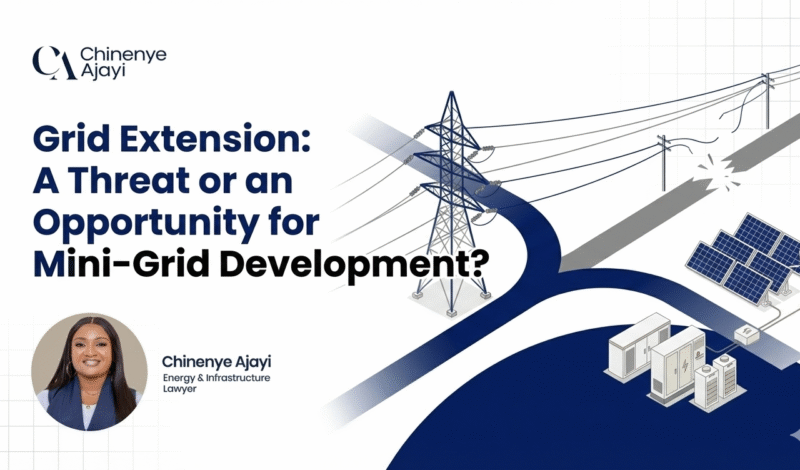

Mini-grids have consistently stood out as one of the most viable solutions, particularly where communities have sufficient population density, growing productive-use demand, and clear socioeconomic potential. They offer a balance between scale and flexibility, providing more power than stand-alone systems while avoiding the heavy capital intensity of full grid extension.
However, despite these advantages, mini-grids continue to face a fundamental tension: the possibility that the national grid may eventually arrive.
This tension raises a critical and recurring question for policymakers, developers, and investors alike: does grid extension represent a threat to mini-grid development, or can it be transformed into an opportunity?
The answer, in truth, is that grid extension can be either depending largely on regulatory design, technical planning, and financial clarity.
Why Grid Extension Creates Investor Anxiety
From an investment perspective, mini-grids are long-term infrastructure assets whose viability depends on predictable revenues over time. Capital is deployed upfront, often in challenging environments, with the expectation that demand growth and stable tariffs will allow for cost recovery and reasonable returns. The possibility of sudden grid extension disrupts this logic.
Investor anxiety arises primarily from uncertainty. If the grid arrives without a clear framework governing what happens to an existing mini-grid, the developer risks losing customers overnight, particularly if grid tariffs are lower.
Even more troubling is the prospect of uncompensated or poorly compensated takeovers, where assets are stranded despite years of operational performance. Where regulations are silent, discretionary, or weakly enforced, grid extension becomes a material risk rather than a sign of progress.
When Grid Extension Becomes an Opportunity
Grid extension does not have to signal the end of a mini-grid. In jurisdictions with thoughtful regulatory frameworks, it can instead mark a transition to a new phase of value creation. Where policy allows, mini-grid operators may retain their assets and reconfigure their role within a larger electricity ecosystem.
In such contexts, a mini-grid can evolve into a distributed generation asset, selling power into the main grid rather than solely to end-users. Alternatively, it may continue serving its community while interconnected to the grid, enhancing reliability and resilience. Grid extension can also provide a structured exit pathway, where developers are fairly compensated for their assets and risks, freeing capital for redeployment into new underserved areas.
Two operational concepts are possible in terms of grid extension. First is island mode, where the mini-grid can continue supplying power independently when the national grid fails. This capability is critical in weak-grid environments and enhances resilience for end-users. Second is the potential for the mini-grid to operate as a dispatchable asset, supplying power to the grid when required.
Whether a mini-grid can perform either function depends largely on design choices made long before the grid arrives especially in relation to voltage and frequency control, protection systems, and system stability. This is because poorly managed interconnections can compromise both customer supply and grid integrity.
One of the most delicate issues in grid extension scenarios is tariff alignment. Mini-grid tariffs are typically higher than grid tariffs, reflecting smaller scale and higher financing costs. When the grid arrives, new commercial arrangements must therefore be negotiated, often involving revised tariffs, power purchase agreements, or a reallocation of generation and distribution roles. Where regulations clearly guide this transition, negotiations can become quicker and certain further strengthening investor confidence.
Nigeria as a Case Study: Policy Progress and Practical Gaps
Nigeria offers a useful illustration of both progress and remaining challenges. The Nigerian Electricity Regulatory Commission has taken deliberate steps through the Nigeria Mini-Grid Regulation 2023 to recognise grid extension as a foreseeable scenario rather than an exceptional event. Section 20 of the Regulation establishes a compensation regime where a distribution company takes over a mini-grid and outlines how compensation may be calculated.
This is a positive signal to investors. However, bankability ultimately depends on practice, not just policy text. Questions remain around implementation timelines, valuation disputes, enforcement strength, and whether such mechanisms have been tested at scale. Until these questions are resolved through real-world application, some level of investor caution will remain.
Practical Insights for Developers and Investors: Protecting Value in the Face of Grid Extension
Beyond policy advocacy, there are very practical steps that mini-grid developers and investors can take to protect their projects before, during, and after construction.
1. At the project development stage, developers should begin with informed site selection. This means not only assessing current demand and ability to pay, but also understanding grid expansion plans in the area. Engaging early with utilities, regulators, and local authorities can provide valuable insight into whether grid extension is likely within the project’s expected payback period. Where the grid is expected in the medium term, this should be reflected transparently in the project’s risk assessment and financial modelling.
2. During project design, systems should be built with future interconnection in mind. This includes selecting equipment and protection systems that meet grid-code standards, designing networks that can accommodate synchronization, and ensuring that the mini-grid can operate in island mode if required. These decisions may increase upfront costs slightly, but they significantly enhance long-term flexibility and asset value.
3. From a contractual and regulatory perspective, developers should ensure that permits, licences, and agreements explicitly reference grid extension scenarios where possible. Compensation rights, valuation principles, and exit options should be clearly understood and documented. Where the regulatory framework allows discretion, developers should seek clarity early rather than relying on future negotiations under pressure.
4. On the financial side, robust scenario modelling is essential. Financial models should test outcomes under continued isolated operation, grid interconnection, and early exit. Tariff sensitivity, compensation timing, and revenue-sharing scenarios should be stress-tested so that investors understand the full range of possible outcomes. Projects that demonstrate this level of preparedness tend to inspire greater lender and equity confidence.
5. Finally, after commissioning, developers should continue engaging with regulators and utilities, monitor policy changes, and document asset performance meticulously. Strong operational records, audited accounts, and well-maintained assets significantly strengthen a developer’s position if integration or compensation discussions arise in the future.
Conclusion
Whether grid extension is a threat or an opportunity for mini-grids ultimately depends the on foresight by policymakers, regulators, and project sponsors alike. Mini grids are not temporary fixes; they are a central pillar of Africa’s electrification strategy.
Grid extension should therefore be designed to complement, not undermine, mini-grid investments. This requires clear rules on integration, compensation, technical standards, and tariffs, coupled with practical planning by developers from the earliest stages of a project.